Human Parasites affect your health and how you feel.
You can get rid of them quickly, feel better and also get peace of mind! It is important to your health.
| Examples of Protozoan 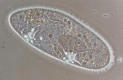 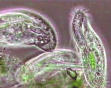 |
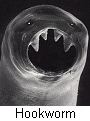
An example of a hookworm 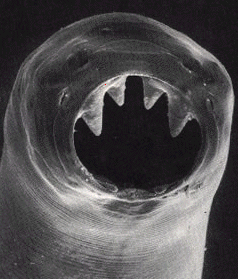 |
Examples of roundworms 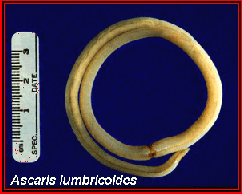 |
This effective parasite cleanse is natural and simple to do.
Human parasites, especially parasites in the intestines and colon are actually fairly common.
Numerous research studies and some well-known authors, say parasites are one of the main causes of many illnesses and diseases.
As well as being disgusting to think about, they can be very irritating and upsetting.

(Easy to follow instructions are included.)
People often think that parasites are a relic of the past when hygiene was more of a problem. However, that is not true. The human body remains the perfect host for these parasitic organisms. They have evolved to live inside you!
Can I get parasites too?
There are a number of ways that parasites can end up infecting and growing in the human body.
They are found in contaminated foods, such as meat, fish and poultry, contact with pets and animals and of course other humans.
Many people now travel to "exotic" parts of the world and many types of parasites can be transferred from person to person. Good hygiene is an important precaution but it is not a complete guarantee against infection.
Towards the end of this article are some pictures and more links to help you find out more about this nasty problem. However, if you know you want to get rid of them, here is a great way:
Products
We think the following products are the highest quality available. As well as this, all our kits come with easy to follow steps. AND, we provide full support to help you get through these programs. If you need any help or advice, send us an email or give us a call. Don't be embarrassed. We have literally helped thousands already, and we are here to help.
More information about the related programs
It can often be useful to do a cleansing program as well as the specific anti-parasite program to maximise the benefits.
Here is more data about the intestinal and colon cleansing
- Click here >> Information about the additional colon cleanse program.
Because these two programs are often done together, we have created the "Ultimate" Anti Parasite package. This works out cheaper for you when they are bought together. This package consists of the anti parasite program pictured above as well as the colon cleanse. Here is some more information about this:
Did you know that parasites can upset your system so much, that they can affect how you feel all day long, not just during the night!
Human Parasites - Cleansing Program Information:
The subject of parasites can be a bit of a shock and hard to face up to. Lots of people don't realise that parasites are fairly common and they may be a significant cause of numerous problems with the body. All of us are familiar with catching a bug such as a virus or a bacterial infection, but worms and parasites are something else.
These critters can actually live quite happily inside a human body and most of us try to pretend or ignore that it is possible. It is a fact of life on this planet and you only have to watch a few nature programs to realise just how "clever" life forms can be, in an attempt to survive and multiply. But we can be clever too and get rid of these things!
Read up on the subject
Anyone who has had pets for a while such as dogs or cats may be more aware of parasites. It is not too uncommon for your pets to get infected and to have to take a trip to a vet to get some kind of treatment. Human parasites exist in the same way, and not just in third world countries. Try to learn more about them and so be better armed in your fight to get rid of them if that becomes necessary.
Parasites can be responsible for a wide spectrum of ailments, from very serious infections and diseases at one end, to mild feelings of unwellness and lack of energy. As well as this article, we have put together lots of useful links from around the internet which go into the subject in much more detail. See the bottom of this page for more details.
Know the enemy
The only cast iron way to be sure you don't have parasites living in your body is to have a stool and blood analysis done in a laboratory at huge cost, which specifically looks for parasites. (Some general tests don't reveal this, as the possible problem of parasites is often underestimated). Most people would usually only have the "privilege" of having this done if they were very ill. So are there any symptoms or things to look out for to see if parasites are a possible problem? Carry on reading here and also read the various links below from other sites and get educated on this subject.
Parasites are everywhere, and they are very easy to contract from our food, water, animals, even from other people. It is recommended that a parasite cleanse is done at least once every year (better twice), preferably with a detox program before or after as well. This in conjunction with more careful attention to hygiene and a greater awareness about parasites will help ensure they do not trouble you.
What Is A Parasite?
A parasite is an organism which feeds off, and usually within, a host body, such as our own body, or other living organisms, like plants and animals. They feed on the nutrients, cells, blood and organs of the host. They reproduce by depositing thousands of eggs, or simply by cell division, within the host's tissues and cells.
They can travel around the body
Parasites are not limited to just the intestines. They can easily move around the blood stream when they are small. They have evolved to move like this, so they can try to find a suitable place to grow and develop. Parasites are often mobile, "grazing" in one area of the body after another, eating the host's cells directly or draining the best of the nutrients directly from the host's tissues. Another nasty side effect of parasites is their fecal secretions (parasite poo), which goes directly into our own bodies. These can be quite toxic and affect a person in different ways. These can also have an effect on the immune system and further weaken the bodies defences often bringing about fatigue and this can lead to further illnesses.
Ok - so who has parasites?
Parasites likely infect everyone at some time. It's estimated that as many as 85% of the world's population is affected. It's believed by some scientists that parasitic infection contributes towards more diseases like cancer, diabetes, liver dysfunction, even HIV infection, and others than has traditionally been accepted.
How do you get parasites?
It is a lot easier than you think and rather widespread. Most of us think that parasites only affect people in certain parts of the world, such as in Africa or in the Amazon jungle. However, this isn't accurate. Firstly many people from western countries now travel to these "exotic" places and get infected. But they can be caught in one's own country. Foods are now imported from different parts of the world. Even salad ingredients can now be transported from an equatorial country and be on our supermarket shelves within 48 hours. So always wash raw foods to be on the safe side.
Gardeners who don't wash their hands properly can get contaminated. Farmworkers, pet groomers, stable workers and anyone who has cats, dogs, rabbits etc. can be more likely to catch something. Walking around barefoot has its many benefits, but it can also be risky if you have a cut or graze. Children can be vulnerable if inconsiderate dog walkers haven't clean up the dog's mess. Here are some more ways --> second part of this parasite series.
Some common parasites
There are a number of major common parasites which can live in the human host and which we should be concerned about. These include:
| Examples of Protozoan |
An example of a hookworm |
Examples of roundworms |
Examples of flukes 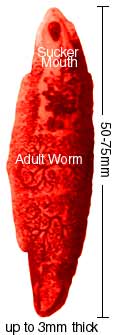 |
Examples of pinworms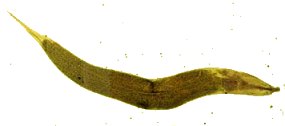 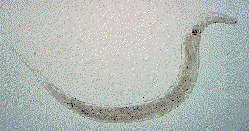 |
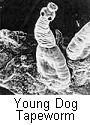
Examples of tapeworms 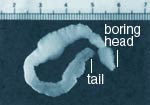 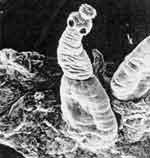 |
Protozoan
Protozoan are organisms that live in the blood, tissues and intestines. Although exceptionally small, these parasites may remain active in the human body for an entire lifetime, causing multiple complications.
Flukes
Flukes (Trematodes), or flatworms, are likely the most common form of parasite found in humans worldwide. These commonly infect one's intestines and other tissues including the heart, lungs, liver and kidneys. Flukes can be difficult to get rid of once infected, and populations of them can increase over a period of 10 to 20 years.
The largest intestinal Fluke: Fasciolopsis buski
Fleshy, red and beef-colored, Flukes attach themselves within the mucous membranes of the small intestine. Living up to one year per adult organism, they proliferate easily and spread to other organs. Transmission can occur through unwashed vegetables, as well as fish and meats, including pork, beef, chicken, turkey and faeces (poo).
Although they normally develop outside the body, new theories suggest that when "propyl alcohols" are used or consumed (either in foods or cosmetics), they provide the fluke with an environment which enables it to complete its entire life cycle within man. This allows the fluke to migrate throughout the body, and they can infest every tissue and organ with which it comes into contact.
Roundworms
Roundworms (Nematodes) include the families of hookworm, pinworm, whipworm, threadworm, etc. Commonly found in the intestines and often contracted through the skin, they, like other parasites, may migrate throughout the body and present multiple symptoms of a disease.
Tapeworms
Tapeworms (Cestodes) are generally the largest of the parasites. These segmented worms, containing 50,000 eggs within each of its 3,000-4,000 segments, can release up to one million eggs per day! Some tapeworms may live as long as 25 years and can grow upwards to 10 meters/33 feet in length within the gastrointestinal tract.
Not every egg that gets laid will hatch and become an adult. However, it is likely that quite a number will. The rest of the eggs may pass out of the body and contaminate the environment. This is part of the life-cycle the organisms have developed.
However, their larvae (pre-adult stages), can be found in almost any organ. They are capable of infecting other tissues during various stages of their development. Parasites have survival skills which can be beyond some of the capabilities of our Immune System. This occurs especially when the immune system is overloaded or weakened, and that's why they can sometimes live for years within their host.
Some tapeworms prefer dogs and cats as their hosts, but these can nevertheless be transmitted to humans via petting, grooming and general contact. Children are especially prone to parasites from pets by coming into contain with faeces in gardens, fields and playgrounds. These parasites can then live in a human host. Tapeworms can live for many years and some individual tapeworms have been removed and dissected, and shown to be more than 20 years old!!
It is important to realise that it can take some days and some effort on your part to handle, but we have put together a program which is very easy to do and requires very little time, literally a few minutes a day. Order our complete anti-parasite kit today. See the product boxes at the top of this page.
Detoxing Recommendation
If your bowel is sluggish or irregular, or you feel bloated or want to do a full cleanse, we suggest that you consider doing a detox as well as the parasite program. In theory, this will give maximum results as after intestinal and colon cleansing, some parasites are more exposed and vulnerable, and so are more easily killed off.
Here is some more information on the detox programs.
Other Parasite Sites
If you want to find out more about parasites we have put together some useful links from around the internet. These pages open in a new browser window:
Parasite Links and Useful Information
| Excellent pictures of many species of parasites. All of them have their latin names which can be a bit confusing, but the information is great. | |
| Click here - http://www.k-state.edu/parasitology/625tutorials/index.html |
|
| An excellent site with images and useful information. Believed to be part of a large government scheme to educate the public more on these types of issues. | |
| Click here - https://www.cdc.gov/dpdx |
|
| Excellent site - many links & data. Same site as above but entered differently into a different section. | |
| Click here - https://www.cdc.gov/dpdx |
|
| Slightly watered down public site using data from the above two links, but still a good summary of some of the parasite problems. | |
| Click here - https://www.cdc.gov/parasites/ |
|
| Here's a Movie clip of a parasite moving along. | |
| Click here - http://www.cellsalive.com/qtmovs/crypto_mov.htm |
|
| National Institute of Allergy and Infectious Diseases (NIAID) - Various articles concerning parasites and worm infections |
|
| Click here - http://www.niaid.nih.gov/topics/Pages/default.aspx |
|
The Parasites Problem
Parasites are far more common than people think. They are nothing to be ashamed of.
So don't get upset with yourself if you think you have parasites.
However, the important thing is to take action straight away and get rid of them.
Types of parasites
There are many different types of parasites which can affect humans.
Here is a small sample: (more can be seen in the article below and on the various other pages)