How to avoid heart disease and what you can do
The following article gives information about the heart and some information regarding natural heart strengtheners.
Heart research is being carried out continually and many natural health boosters and benefits are being discovered. It is well known that garlic helps to promote a healthy heart. Well, this is just the start.
As part of our regular newsletter, there will be examples of successful alternative heart helpers.
A healthy heart and avoiding heart disease
The average heart beats about 72 times a minute and pumps about 13,640 litres (3,600 gallons) of blood a day, which is an almost unbelievable amount. During exercise, the pumping action automatically increases significantly, in response to the tissue's demand for increased oxygen. A strong healthy heart is important to everyone, regardless of age or sex. (Here is some separate info about the heart and blood circulation).
Don't let it become a killer
Heart disease is one of the biggest killers and every year billions are spent on the treatment and prevention of heart disease. Anyone suspecting or feeling heart problems must see a qualified physician immediately. If a diagnosis is made which suggests that heart health should be better, then you must undertake a change to a more healthy lifestyle. As with all illnesses, prevention is better than cure if possible. Following a healthy lifestyle will definitely lessen any chance of heart disease.
Never take heart health for granted. It is ridiculously important. People's lives can end or be dramatically changed in just a few minutes. In most cases, there are warning signs. You have to be aware enough of your own body and health that you can spot when things are not right.

Don't leave things to chance - take action
Hopefully, you can get your health in such good shape that it does not even become noticeable that something is not right. Let's all make this something that never happens to us.
Exercise, keeping weight in a healthy range, not smoking and effective stress management are excellent preventive therapies. If you are taking drugs for heart problems, seek professional advice before taking any herbal medicine in case of interactions.
Unless there is a genetic predisposition regarding a bad heart, the main factors in heart attacks, disease or strokes, seems to be poor lifestyle issues, which have increased the chances of this occurring. Thankfully, these poor choices can be reversed with some time, willpower and action.
Atherosclerosis
One of the most well-known heart diseases is Atherosclerosis. This technical word comes from Greek atheroma meaning "inside" and Greek sklerosis, meaning "hardening," from skleros "hard". So this word means hardening of tissues and cells inside the blood vessels and arteries etc.
It is a degenerative disease of the arteries characterised by patchy thickening of the inner lining of the arterial walls. It is often caused by deposits of fatty material. This eventually hardens and partially blocks the artery, usually causing the formation of a blood clot behind it. Generally, this condition worsens with age, and is most dangerous when the arteries supplying blood to the heart and brain are affected.
It is an indicator of eating the wrong foods for your body and/or eating too much. The usual advice still applies: eat sensibly, don't eat too much food, even if it is healthy food. Get the blood pumping vigorously around the body, at least once per day. A good indicator is when the body sweats a bit. When this happens, the blood is moving around more than normal and helping to get rid of junk in the bloodstream.
It is always important to take a sensible approach to exercise. Don't do too much too soon, especially if you are older or haven't exercised for a while. It is far better to make gradual progress with exercise or any weight loss program, rather than risk injury or lose willpower because something seems too extreme to continue with.
Angina
Other conditions include: Angina (known medically as angina pectoris) is chest pain caused by a narrowing of the arteries. This results in the blood supply to the heart muscle itself being insufficient to meet its own demands for oxygen and nutrients.
Did you know that the word Angina comes from a Latin word meaning "to tighten". This same early Latin word also forms the origin of the words, anger, anguish, anxious and angst. I'm sure it isn't a coincidence that angry or anxious people also seem to get more chest pains and discomfort than most.
Stress by itself can be positive. It can make you work efficiently, it can make things fun. But stress combined with a bad attitude or upset can be a very negative thing. So having a positive outlook on life, not being too serious when bad things happen to us and remaining calm in a stormy sea will all have a positive effect on our wellbeing.
Palpitations
Palpitations refer to fast or irregular heartbeat. They are quite common and usually harmless. Palpitations are often brought on by physical exertion or fright. One of the most common times that palpitations can occur is when you go to bed and start to go to sleep. It could be that after lying down, the blood flow changes due to gravity and this can cause a flutter. One way to overcome this is to relax and to take some deep breaths. Usually, 5 or 6 good slow deep breaths seems to bring things under control.
If you experience frequent or prolonged palpitations, it may be an indication of heart disease. This is often accompanied by dizziness, fainting, or chest pain. You MUST immediately contact your doctor or hospital and get this checked out. They are experts in serious heart problems and they have the equipment to properly monitor how well your heart is operating. DO NOT leave things to chance if you sense something isn't right. Get a proper diagnosis. Then you can decide on the best way to treat this and on the lifestyle changes you need to make.
There are lots of natural methods and supplements which have been shown to benefit in maintaining healthy blood flow and a healthy heart
Cayenne
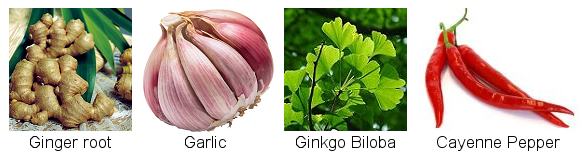
Possibly the best herb to help with any heart or circulatory problem is cayenne. It is also known as Capsicum, the botanical name being Capsicum frutescens. Cayenne is the species of capsicum that is used traditionally for its stimulant and antiseptic actions, as well as its digestive properties. It is easily demonstrated to aid with blood flow and it really brings about a surge of energy as the blood is more quickly delivering nutrients throughout the body.
Internally, cayenne stimulates the heart, regulating the blood flow and strengthening the arteries and capillaries. If you want to get your blood flowing, and your face red with blood, take cayenne tincture. It will not only get the blood pumped around your body, but it will strengthen your heart and clear your arteries. Cayenne can also be used externally for poor circulation and on unbroken chilblains, Cayenne is a wonderful herb.
Garlic
For a healthy heart eat plenty of Garlic. Garlic has long been known to help prevent heart disease and reduce the risk of atherosclerosis. It also helps to reduce high blood pressure. Modern research has shown that regular intake of garlic lowers cholesterol levels in the blood, and reduces blood clotting in blood vessels, making it particularly useful for coronary/artery disease. Garlic can be taken in food or for higher strength in the form of a tincture.
Hawthorn
Hawthorn has a well-established and well-deserved reputation as a heart tonic. The ancient Greeks and Romans considered its blossom to be a symbol of joy and hope, and made it into wedding bouquet. Today it is particularly valued for its strengthening and normalising effect on the heart.
In medical studies and research work, the berries lowered blood pressure by helping to dilate clogged and hardened arteries. It also increases the heart's ability to cope with a loss of oxygen, which is what happens when clogged coronary arteries reduce the heart's blood supply.
The flowers help to strengthen weak or ageing hearts. Hawthorn also eases the painful chest-constriction characteristic of angina, and can help to regularise an erratic heartbeat. Whilst hawthorn obviously won't help every kind of heart problem, it can be of therapeutic value for some. Hawthorn can be taken as a tincture: one tsp in a little water daily, or as a tea made from flowering tops or a decoction of the berries.
Ginger
In various studies, ginger has been shown to be almost as effective as aspirin and garlic in preventing the blood clots that trigger heart attacks. Many people associate this herb with overcoming travel sickness and assisting with stomach sickness such as sea-sickness. But it works very well in combination with the other herbs mentioned here.
Ginkgo Biloba
Ginkgo Biloba improves blood flow through the heart and brain by opening (dilating) the arteries. As mentioned above, stress can play a part with high blood pressure and some heart conditions. College and University students are well known for taking this herb as well as lemon balm to assist with their studies. Apparently, these herbs have been shown to have some benefit with one's memory. Perhaps this is due to improved blood flow which in turn helps increase the oxygen transmitted to the cells.
Valepotriates is one of the active ingredients in valerian root. This has been shown to calm the central nervous system as it seems to act as a natural sedative. It has been shown to be a natural stress reliever. This has beneficial effects on the heart, as well as calming the heart, it helps with palpitations. It has also shown to help lower blood pressure.
Rosemary
Rosemary is one of the richer herbal sources of antioxidants, which is why it works so well as a food preservative. Its antioxidants help prevent the fats in meat from turning rancid. The same principle applies to your heart. It is also a circulatory stimulant and it may help dilate the blood vessels.
Lemon Balm
Lemon Balm helps to reduce high blood pressure and helps to calm palpitations and rapid breathing.
If you need any more help or advice then please let us know.